
Members Login


Channels
Special Offers & Promotions
Determination of Ginsenosides in Panax Ginseng - New method announced by Thermo Fisher Scientific
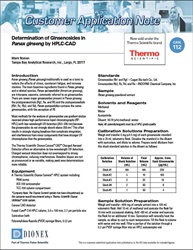 Thermo Fisher Scientific is pleased to announce
a new method that uses the Thermo Scientific Dionex Corona CAD Charged Aerosol Detector to
provide a reliable alternative to low-wavelength UV detection. Customer Application Note (CAN)
112: Determination of
Ginsenosides in Panax ginseng by HPLC-CAD demonstrates that charged aerosol detection
does not overrespond to strong chromophores, thereby reducing interferences.
Baseline slopes are not as pronounced or as variable, making peak area
determinations more reliable.
Thermo Fisher Scientific is pleased to announce
a new method that uses the Thermo Scientific Dionex Corona CAD Charged Aerosol Detector to
provide a reliable alternative to low-wavelength UV detection. Customer Application Note (CAN)
112: Determination of
Ginsenosides in Panax ginseng by HPLC-CAD demonstrates that charged aerosol detection
does not overrespond to strong chromophores, thereby reducing interferences.
Baseline slopes are not as pronounced or as variable, making peak area
determinations more reliable. Asian ginseng (Panax ginseng) traditionally is used as a tonic to reduce the effects of stress, counteract fatigue, and increase stamina. The main bioactive ingredients found in Panax ginseng and a related species, Panax quinquefolius (American ginseng), are triterpene saponins, commonly referred to as ginsenosides. Most methods for the analysis of ginsenosides use gradient elution reversed-phase high-performance liquid chromatography (RP-HPLC) with low-wavelength UV detection (203-205 nm) because the ginsenosides do not strongly absorb above 205 nm. This often results in strongly sloping baselines that complicate integration, and interferences from minor components that have stronger UV chromophores than the ginsenosides.
This customer application note and many others can be found at www.thermoscientific.com/dionex under the Documents tab.
Subscribe to any of our newsletters for the latest on new laboratory products, industry news, case studies and much more!

Popular this Month
Top 10 most popular articles this month
Today's Picks
Looking for a Supplier?
Search by company or by product
Please note Lab Bulletin does not sell, supply any of the products featured on this website. If you have an enquiry, please use the contact form below the article or company profile and we will send your request to the supplier so that they can contact you directly.
Lab Bulletin is published by newleaf marketing communications ltd.
Media Partners