
Members Login


Channels
Special Offers & Promotions
Duke University uses Nanoparticle Tracking Analysis to characterize "nanoconstructs" for biomedical applications
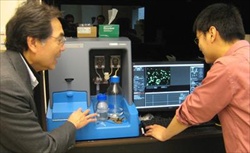 NanoSight, leading manufacturers of unique
nanoparticle characterization technology, reports on the work of Professor Tuan
Vo-Dinh's group at Duke University where they apply Nanoparticle Tracking
Analysis (NTA) to characterize metal nanoparticle construct materials for use
in biosensing, imaging and cancer therapy.
NanoSight, leading manufacturers of unique
nanoparticle characterization technology, reports on the work of Professor Tuan
Vo-Dinh's group at Duke University where they apply Nanoparticle Tracking
Analysis (NTA) to characterize metal nanoparticle construct materials for use
in biosensing, imaging and cancer therapy. The Vo-Dinh Lab is a part of the Departments of Biomedical Engineering and Chemistry of Duke University. The Vo-Dinh Lab is also a part of the Fitzpatrick Institute for Photonics, of which Professor Vo-Dinh is the director.
The main research goal of the group is to develop advanced techniques and methods to protect the environment (environmental sensors) and improve human health (medical diagnostics and therapy). As a part of these research goals, Dr Hsiangkuo Yuan and other members of Professor Vo-Dinh's group design and fabricate metal nanoparticle constructs such as gold nanostar platforms. These are characterized with UV-VIS, TEM, Raman microscope, fluorometers and other techniques. However, to design nanoconstructs for in vivo applications, the particle size needs to be in the range from 10 to 100 nm for lower clearance from the kidney and reticuloendothelial system (RES). It is important that the construct is in the right size range and is physiologically stable (non-aggregated) for biomedical applications in, for example, optical imaging or nanodrug delivery where it is also critical that the nanoparticle dose administered can be determined. To compare plasmonic properties, i.e. the enhanced electromagnetic properties of nanoparticles, they need to determine the effect of different sizes and to understand in detail the profile of the particle size distribution of similar concentrations which can be obtained using NanoSight's NTA system.
Prior to NTA, the group mostly used TEM to look at particle shape and measure particle size. The surface coating or the aggregation state cannot be easily investigated using just TEM. NanoSight provides a significant complementary role on providing hydrodynamic size distribution and zeta potential. Moreover, because NanoSight gives the concentration information, it allows them to normalize their comparison by individual particle counting which was quite difficult to obtain previously.
Commenting on the benefits of using the NanoSight alongside TEM (for size) and atomic absorption spectroscopy (for mass), Professor Vo-Dinh said the ability to make characterization particle by particle provides complementary information to the ensemble characterization (e.g. DLS). The group have published nanoconstruct data, specifically gold nanostars, in the journal, Nanotechnology, with another paper currently in press, Nanomedicine. They report the determination of particle hydrodynamic size distribution, zeta potential and concentration using NTA.
To find out about the company and to learn more about particle characterization using NanoSight's unique nanoparticle tracking analysis solutions, visit www.nanosight.com and register to receive the next issue of NanoTrail, the company's electronic newsletter.
Subscribe to any of our newsletters for the latest on new laboratory products, industry news, case studies and much more!
Popular this Month
Top 10 most popular articles this month
Today's Picks
Looking for a Supplier?
Search by company or by product
Please note Lab Bulletin does not sell, supply any of the products featured on this website. If you have an enquiry, please use the contact form below the article or company profile and we will send your request to the supplier so that they can contact you directly.
Lab Bulletin is published by newleaf marketing communications ltd.
Media Partners