
Members Login


Channels
Special Offers & Promotions
Merck Millipore Launches Direct Detect Biomolecular Quantitation System, Offering Significant Advantages over Bradford and Lowry Assays
 Uses novel membrane
technology for rapid and simplified sample preparation
Uses novel membrane
technology for rapid and simplified sample preparation- Infrared-based spectrometry system provides accurate, sequence-independent analysis that requires minimal sample size
- Overcomes limitations of traditional protein quantitation methods such as Lowry and Bradford assays
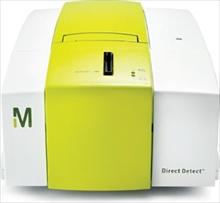
Merck Millipore, the Life Science division of Merck KGaA of Darmstadt, Germany, today launched the Direct DetectTM system for rapid, simplified protein quantitation. The Direct DetectTM system exploits Merck Millipore's membrane expertise to enable infrared-based measurement of amide bonds in protein chains, an intrinsic component of every protein, without relying on amino acid composition, dye-binding properties, or redox potential. Conventional assays based on UV-Vis spectroscopy rely on absorbance by a protein's aromatic amino acids and therefore have limited utility.
"In addition to its analytical powers, the Direct DetectTM system provides a groundbreaking departure from traditional sample prep requirements typical of biomolecular quantitation. After samples are spotted on assay cards, they can be stored in ambient conditions without appreciable change in readout," describes John Sweeney, Head of Life Science Business Field, Merck Millipore. "Another important advantage over conventional assays is that the Direct DetectTM calibration standard curve requires generation once, which provides additional time savings and ease of use."
The system employs a hydrophilic polytetrafluoroethylene (PTFE) membrane designed to be transparent in most of the infrared spectral region and enables application of biomolecule solutions directly onto the membrane. The Direct DetectTM system delivers more universally applicable and faster protein quantitation, requiring minimal sample consumption. System accuracy and precision are comparable with results obtained by amino acid analysis, an accurate standard for quantitation, yet can be time-consuming and often costly.
Because the system relies on IR-based detection of biomolecules, users can obtain accurate and reproducible protein quantitation in presence of reducing agents and detergents. As a result, the Direct DetectTM system can measure protein concentrations from 0.2 mg/mL to 5 mg/mL within seconds, without any bio- or immunochemical staining, directly from samples, including buffered solutions.
The Direct DetectTM system can also be used to provide information on non-protein sample components, such as lipids and nucleic acids.
For more information, please visit http://www.millipore.com/directdetect
Subscribe to any of our newsletters for the latest on new laboratory products, industry news, case studies and much more!

Popular this Month
Top 10 most popular articles this month
Today's Picks
Looking for a Supplier?
Search by company or by product
Please note Lab Bulletin does not sell, supply any of the products featured on this website. If you have an enquiry, please use the contact form below the article or company profile and we will send your request to the supplier so that they can contact you directly.
Lab Bulletin is published by newleaf marketing communications ltd.
Media Partners