
Members Login

Channels
Special Offers & Promotions
New Possibilities for Multiphoton Microscopy from Carl Zeiss
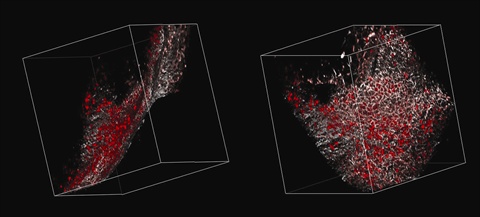
Multiphoton confocal microscopes from Carl Zeiss now permit the simultaneous use of two NLO lasers or one laser with an optical parametric oscillator (OPO). Both components are fully integrated and expand the functionality of the multiphoton systems.
In dual laser systems different laser wavelengths simultaneously excite several fluorescent dyes or proteins. Without time loss, users can image specimens with one wavelength and manipulate them in the multiphoton mode with another. The automatic free beam adjustment gives the system a high degree of stability and reproducibility and ensures exact overlay of the two excitation beams. Such dual laser systems are used, above all, in intravital microscopy, e.g. for examining functional correlations in the brain of a mouse.
An OPO increases the excitation range of multi- photon microscopy to up to 1300 nanometers and therefore covers in particular the absorption peak of red fluorescent proteins such as mCherry, mPlum and tdTomato. This efficient, long-wave excitation enables excellent specimen protection. The potentially very high light intensities of the OPO lasers interact with specific structures in the tissue, leading to a doubling and tripling of the oscillation frequency. This non-linear effect of frequency doubling (SHG) occurs, for example. in striated skeletal muscle and collagen. Frequency tripling is especially visible on regions where structures with inconsistent optical density converge. These include lipid-water boundaries - for example, between membrane and cytoplasm.
For further information click here
Subscribe to any of our newsletters for the latest on new laboratory products, industry news, case studies and much more!

Popular this Month
Top 10 most popular articles this month
Today's Picks
Looking for a Supplier?
Search by company or by product
Please note Lab Bulletin does not sell, supply any of the products featured on this website. If you have an enquiry, please use the contact form below the article or company profile and we will send your request to the supplier so that they can contact you directly.
Lab Bulletin is published by newleaf marketing communications ltd.
Media Partners