
Members Login


Channels
Special Offers & Promotions
New application note explores the optimisation of targeted DNA sequencing
Improving custom bait design to
increase accuracy, sensitivity and coverage depth
 Oxford Gene Technology (OGT), provider
of innovative clinical genetics and diagnostic solutions to advance
molecular medicine, has released a new
application note exploring the optimisation of targeted DNA sequencing.
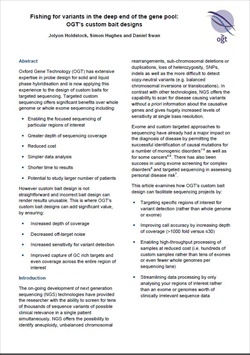
Entitled, "Fishing for variants in the deep end of the gene pool", the document
discusses how the intelligent design of custom bait probes can significantly improve
data quality by decreasing off-target noise, increasing the depth of coverage
and optimising the sensitivity of variant detection. Well-designed probes can
also be used to investigate GC-rich areas of the genome, thereby ensuring
studies are not biased towards low-GC regions.
Oxford Gene Technology (OGT), provider
of innovative clinical genetics and diagnostic solutions to advance
molecular medicine, has released a new
application note exploring the optimisation of targeted DNA sequencing.
Entitled, "Fishing for variants in the deep end of the gene pool", the document
discusses how the intelligent design of custom bait probes can significantly improve
data quality by decreasing off-target noise, increasing the depth of coverage
and optimising the sensitivity of variant detection. Well-designed probes can
also be used to investigate GC-rich areas of the genome, thereby ensuring
studies are not biased towards low-GC regions.
Whilst whole exome sequencing offers a powerful route into analysis of Mendelian disorders and provides a platform for GWAS studies, custom designs offer significant advantages where the biological question is more focused. Examples include the follow up of genome wide association studies (GWAS) or investigations into the mutational analysis of specific pathways or genes in a clinical context. Targeted sequencing offers greater depth of coverage, reduced cost, simpler data analysis and shorter time to results. However, the design of custom baits for such studies is not straightforward and poor design strategies can render the results unusable. For this reason, through its GenefficiencyTM Targeted Sequencing Services, OGT leverages its expertise in probe design for solid and liquid phase hybridisation to create custom bait probes optimised for each individual study, ensuring accurate, unbiased results that provide true biological insight.
To find out more, download the new application note now or visit www.ogt.co.uk
For more information on the range of genomic services offered by OGT.
Oxford Gene Technology (OGT), provider
of innovative clinical genetics and diagnostic solutions to advance
molecular medicine, has released a new
application note exploring the optimisation of targeted DNA sequencing.
Entitled, "Fishing for variants in the deep end of the gene pool", the document
discusses how the intelligent design of custom bait probes can significantly improve
data quality by decreasing off-target noise, increasing the depth of coverage
and optimising the sensitivity of variant detection. Well-designed probes can
also be used to investigate GC-rich areas of the genome, thereby ensuring
studies are not biased towards low-GC regions.Whilst whole exome sequencing offers a powerful route into analysis of Mendelian disorders and provides a platform for GWAS studies, custom designs offer significant advantages where the biological question is more focused. Examples include the follow up of genome wide association studies (GWAS) or investigations into the mutational analysis of specific pathways or genes in a clinical context. Targeted sequencing offers greater depth of coverage, reduced cost, simpler data analysis and shorter time to results. However, the design of custom baits for such studies is not straightforward and poor design strategies can render the results unusable. For this reason, through its GenefficiencyTM Targeted Sequencing Services, OGT leverages its expertise in probe design for solid and liquid phase hybridisation to create custom bait probes optimised for each individual study, ensuring accurate, unbiased results that provide true biological insight.
To find out more, download the new application note now or visit www.ogt.co.uk
For more information on the range of genomic services offered by OGT.
Subscribe to any of our newsletters for the latest on new laboratory products, industry news, case studies and much more!

Popular this Month
Top 10 most popular articles this month
Today's Picks
Looking for a Supplier?
Search by company or by product
Please note Lab Bulletin does not sell, supply any of the products featured on this website. If you have an enquiry, please use the contact form below the article or company profile and we will send your request to the supplier so that they can contact you directly.
Lab Bulletin is published by newleaf marketing communications ltd.
Media Partners