
Members Login


Channels
Special Offers & Promotions
Non-invasive instrument for skin cancer screening demonstrated
 Skin cancer is the most common form of human cancer
with annual rates continuing to climb from their current estimate of just over
three million new cases each year. Although all skin cancers share the
likelihood of a favourable outcome if early diagnosis and complete resection
are achieved, diagnosis is invasive, subjective, lengthy and expensive
involving expert visual inspection, biopsy and histopathology.
Skin cancer is the most common form of human cancer
with annual rates continuing to climb from their current estimate of just over
three million new cases each year. Although all skin cancers share the
likelihood of a favourable outcome if early diagnosis and complete resection
are achieved, diagnosis is invasive, subjective, lengthy and expensive
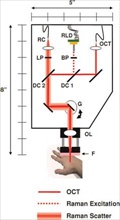
involving expert visual inspection, biopsy and histopathology.Now, a joint US-Dutch team under the direction of Anita Mahadevan-Jansen, Vanderbilt University, US, has developed a non-invasive probe capable of both morphological and biochemical characterization of skin cancers. The portable instrument combines a Raman spectroscopy (RS) system with an Optical Coherence Tomography (OCT) device and enables sequential acquisition of co-registered OCT and RS data sets. An Andor high resolution, near-infrared-enhanced Newton camera was chosen as the core element of the Raman diagnosis module. The probe will screen large areas of skin up to 15 mm wide to a depth of 2.4 mm with OCT to visualize microstructural irregularities and perform an initial morphological analysis of lesions. The OCT images are then used to identify locations to acquire biochemically specific Raman spectra.
"Due to the inherently weak nature of Raman scattering and the relatively intense background autofluorescence from tissue, collection efficiency is a critical factor in the design of clinical RS probes," says Chetan A. Patil, Vanderbilt University, US. "Unlike confocal approaches that emphasize axial resolution, our probe is designed to prioritize collection efficiency. The high sensitivity of the Andor Newton CCD's back-illuminated, deep-depletion, thermo-electrically cooled design is well suited to the stringent demands of in vivo Raman spectroscopy.
"Having demonstrated the clinical potential of the RS-OCT instrument to rapidly screen at risk patients, we are continuing to develop the dual-modal technique for other applications where non-invasive assessment of both microstructure and biochemical composition are critical to accurate assessment of pathology. The Labview software development kit, which is supplied with the camera and supported directly by Andor, was crucial in the development of our first probe and in our on-going research," concludes Patil.
According to Antoine Varagnat, Product Specialist at Andor, "With its high sensitivity in the NIR enabled by high Quantum Efficiency and deep TE-cooling interface, the Newton Deep-Depletion CCD platform is just the right detector for demanding clinical NIR spectral diagnosis. One also gets the benefit of long-lasting detection performance and reliability with Andor's UltraVacTM vacuum technology, alongside high speed acquisitions and ease of integration."
Andor's modular Spectroscopy solutions encompass a wide range of high performance CCD, ICCD, EMCCD and InGaAs array detectors, as well as a comprehensive range of Research-grade spectrograph platforms. To learn more about the Newton camera series and their use in spectroscopy, please visit the Andor website spectroscopy pages
Subscribe to any of our newsletters for the latest on new laboratory products, industry news, case studies and much more!

Popular this Month
Top 10 most popular articles this month
Today's Picks
Looking for a Supplier?
Search by company or by product
Please note Lab Bulletin does not sell, supply any of the products featured on this website. If you have an enquiry, please use the contact form below the article or company profile and we will send your request to the supplier so that they can contact you directly.
Lab Bulletin is published by newleaf marketing communications ltd.
Media Partners