
Members Login


Channels
Special Offers & Promotions
Thermo Fisher Scientific ICP-MS Implemented by University of Oviedo for Reliable and Efficient Sulfur Detection in Proteins
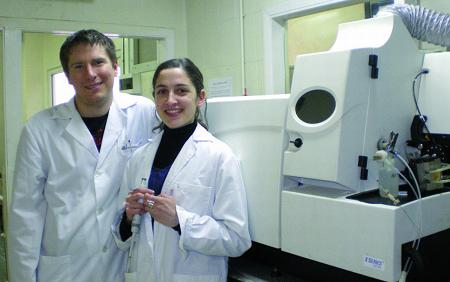 Thermo Fisher Scientific Inc., the world leader in serving science, today announced that the University of Oviedo's analytical spectrometry research group has implemented the Thermo Scientific XSERIES 2 ICP-MS to perform reliable and interference-free sulfur detection in proteins. In the past, interference from gas-based polyatomics has made the accurate determination of sulfur isotopes particularly challenging for the research group. The XSERIES 2 ICP-MS has overcome these issues, offering high levels of accuracy while also optimizing the efficiency of analyses.
The analytical spectrometry research group at the University of Oviedo in Asturias, Spain aims to solve the analytical challenges encountered by science and technology. Within this framework, a small sub-group has been established focusing on the development of inductively coupled plasma-mass spectrometry (ICP-MS) based analytical methods for the quantification of biopolymers such as DNA and proteins. One of the principal issues faced by the group is the interference from gas-based polyatomics such as oxygen in the determination of sulfur when using a low resolution instrument. To eliminate these problems, the group selected the Thermo Scientific XSERIES 2 ICP-MS with collision/reaction cell technology (CRC).
Quantitative protein analysis is currently one of the most demanding applications in analytical chemistry. Mass spectrometric techniques such as electrospray ionization-mass spectrometry (ESI-MS) and matrix assisted laser desorption ionization-mass spectrometry (MALDI-MS) have traditionally played a key role in protein analysis. However, the potential of ICP-MS has recently been recognized for the determination of proteins. Although ICP-MS detection does not provide any structural information, its outstanding capability to quantify most of the elements proves valuable for accurate protein quantification. Keeping pace with the latest technological developments, the University of Oviedo's research group has coupled the XSERIES 2 ICP-MS with a reversed-phase capillary liquid chromatography (μLC) system to facilitate precise determination of sulfur isotopes in standard proteins.
Dr. Jörg Bettmer of the University of Oviedo's analytical spectrometry research group comments, "The Thermo Scientific XSERIES 2 ICP-MS was chosen because no other quadrupole-based system matches its capabilities in terms of accuracy, reliability and overall efficiency. The implementation of the instrument has allowed us to achieve reliable, interference-free detection of sulfur isotopes. It has enabled us to determine sulfur-containing standard proteins in an accurate and efficient manner that had not been previously possible."
The XSERIES 2 offers outstanding productivity in a quadrupole ICP-MS for both routine and high-performance analytical applications. By using the system, laboratories can achieve their analytical objectives faster, with greater confidence and less hands-on time from the operator. The innovative ion lens design of the instrument enables simple field upgrade to collision cell technology (CCT) performance without affecting the normal (non-CCT mode) sensitivity or background. The cell is also compatible with a range of reactive gases, such as pure oxygen for interference suppression in challenging matrices.
For more information about the Thermo Scientific XSERIES 2 ICP-MS, please call +1 800-532-4752, email analyze@thermofisher.com or visit http://www.thermoscientific.com/icpms.
Subscribe to any of our newsletters for the latest on new laboratory products, industry news, case studies and much more!

Popular this Month
Top 10 most popular articles this month
Today's Picks
Looking for a Supplier?
Search by company or by product
Please note Lab Bulletin does not sell, supply any of the products featured on this website. If you have an enquiry, please use the contact form below the article or company profile and we will send your request to the supplier so that they can contact you directly.
Lab Bulletin is published by newleaf marketing communications ltd.
Media Partners