
Members Login

Channels
Special Offers & Promotions
Bruker
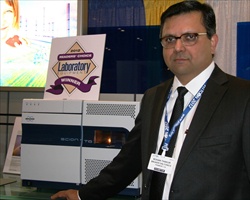 Visitors to
the Bruker exhibition stand (Hall D 4.2 stand L35) at ACHEMA running 18 - 22
June 2012, Frankfurt am Main, Germany- will have the opportunity to view the
latest additions to the SCION range of instrumentation. The revolutionary SCION
solution range of products deliver innovative and practical features providing
chromatographers with the power of mass spectroscopy detection without the
worry of MS method set-up. New technologies from recent acquisitions have
enabled Bruker to develop additional, complimentary high-performance analytical
instrumentation and develop new compact, easy-to-use and affordable turn-key
solutions.
Visitors to
the Bruker exhibition stand (Hall D 4.2 stand L35) at ACHEMA running 18 - 22
June 2012, Frankfurt am Main, Germany- will have the opportunity to view the
latest additions to the SCION range of instrumentation. The revolutionary SCION
solution range of products deliver innovative and practical features providing
chromatographers with the power of mass spectroscopy detection without the
worry of MS method set-up. New technologies from recent acquisitions have
enabled Bruker to develop additional, complimentary high-performance analytical
instrumentation and develop new compact, easy-to-use and affordable turn-key
solutions.Six months after introduction into the market place, the double award winning SCION triple quadrupole (TQ) and single quad (SQ) formats have been accepted by the market. Features that are appreciated by analytical laboratories is that both the SQ and TQ occupy the same amount of bench space. Other key innovations include auto-focusing q0 ion optical element, multi-axis chemical noise reducing design and increased sensitivity. One of the most important innovations is industries first ‘lens-free' design, making it easier to use and decreasing instrument downtime.
In conventional mass spectrometers, lenses function to refocus the beam at critical points along the ion path. The disadvantages of lenses are that they need to be tuned, retuned, cleaned and sometimes even charged to provide optimal performance. The new ‘lens-free' technology by Bruker offers benefits over traditional mass spectrometers, where downtime for maintenance no longer applies. No additional power is required to control the lenses and the overall productivity is improved as well as robustness and enhanced sensitivity. The lens-free technology adopted by Bruker's SCION family of instruments is unique. "For the last 20-30 years GC systems have used lenses to transmit ions from one region to the other. The Bruker SCION has been engineered to transfer ions without the use of lenses, which makes the system so much simpler to use, maintain and clean. This advance in GC technology is unique to the SCION family of instruments and we've continued to utilize this innovation in the new additions to the SCION family of GC solutions" commented Rohan A. Thakur, Vice President of Bruker's Chemical and Applied Markets (CAM) Division.
"The whole objective and idea behind the SCION family was to make this product easier to use in the laboratory, especially since users today are transitioning from single quads to triple quads and we wanted to reduce the barrier to entry. We have achieved this with a piece of software called ‘Compound-Based Scanning' (CBS) where you can simply drag a compound name and it creates an automatic template for method development, making it as easy as running a single quad. Along with this the SCION platforms are more robust, easier to use and provide higher sensitivity, which is key to commercial labs such as a food testing lab where there is demand for both sensitivity and high throughput" commented Thakur.
Visit Bruker at ACHEMA 2012, hall D 4.2 stand L35, or for more details on Bruker's SCION range of products visit www.scionhasarrived.com
Subscribe to any of our newsletters for the latest on new laboratory products, industry news, case studies and much more!
Popular this Month
Top 10 most popular articles this month
Today's Picks
Looking for a Supplier?
Search by company or by product
Please note Lab Bulletin does not sell, supply any of the products featured on this website. If you have an enquiry, please use the contact form below the article or company profile and we will send your request to the supplier so that they can contact you directly.
Lab Bulletin is published by newleaf marketing communications ltd.
Media Partners