
Members Login

Channels
Special Offers & Promotions
The Forschungszentrum Dresden-Rossendorf chooses NanoSight to characterize magnetic nanoparticles
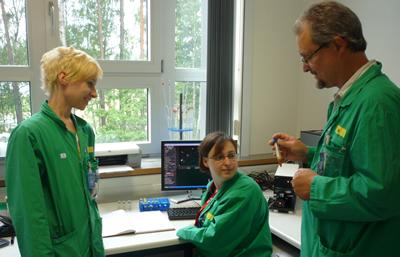 The research team of Dr Holger Stephan is working to develop magnetic nanoparticles which can be applied in cancer therapy, preferably in combination with intracellular hyperthermia/ablation and endoradionuclide therapies. This requires nanoparticles to be very stable under physiological conditions and they should also avoid accumulation in the reticuloendothelial system.
Many techniques had been used to characterize the nanoparticles before Dr Stephan discovered the NanoSight system. These included Photon Correlation Spectroscopy (PCS), scanning electron microscopy (SEM) and ultra centrifugation. The NanoSight ability to track individual particles by the scattering of a laser beam has made the study of nanoparticle stability much more convenient. Nanoparticle Tracking Analysis, NTA, has been used to successfully follow the stability of different systems as a function of temperature in EDTA and different cell media.
There are three specific goals for measurement: First is to get information about the size distribution of nanoparticles and, more importantly, their stability under physiological relevant conditions, Next is to study the influence of nanoparticle surface modification on the size distribution finally to achieve structure-activity relationships for the nanoparticles on the cellular uptake behaviour (first step) and cancer tissue accumulation (second step).
Dr Stephan has described several advantages of the NanoSight LM-20 system. He says "the NanoSight provides reliable results on nanoparticles as small as 50nm. Sample handling and measurement is straightforward and experiments are performed more quickly than using PCS. The ability to work directly with relevant solutions removes another block to quickly understanding the behaviour of these magnetic nanoparticles and their ultimate use in treating cancers."
"Our goal," continues Dr Stephan "is to rewrite the medical paradigm, currently being "see and treat" and to make the future one of "detect and prevent." By working on the combining of different therapeutic methodologies, we will provide synergetic medical effectiveness."
To learn more about nanoparticle characterisation using Nanoparticle Tracking Analysis, NTA, please visit the company website (www.nanosight.com) and register for the latest issue of NanoTrail, the company's electronic newsletter.
Subscribe to any of our newsletters for the latest on new laboratory products, industry news, case studies and much more!
Popular this Month
Top 10 most popular articles this month
Today's Picks
Looking for a Supplier?
Search by company or by product
Please note Lab Bulletin does not sell, supply any of the products featured on this website. If you have an enquiry, please use the contact form below the article or company profile and we will send your request to the supplier so that they can contact you directly.
Lab Bulletin is published by newleaf marketing communications ltd.
Media Partners